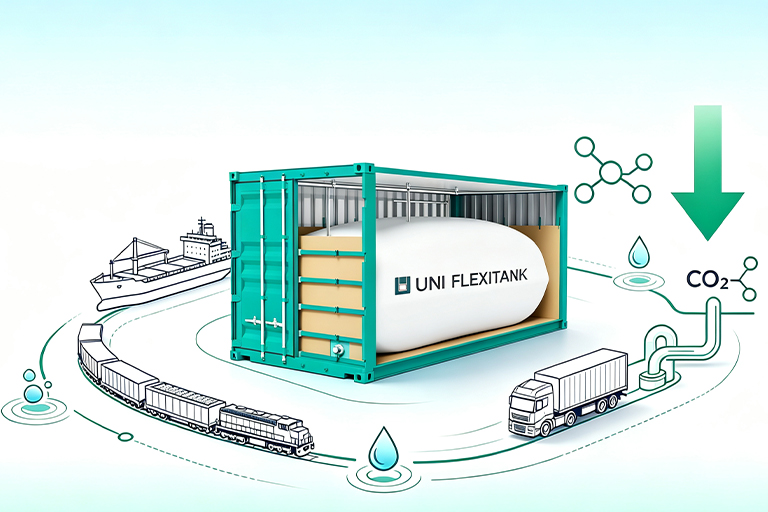


As global supply chains move toward more sustainable logistics, companies are looking beyond product manufacturing to reduce the environmental impact of transportation and packaging. For non-hazardous bulk liquids, the choice of packaging can make a meaningful difference.
Compared with drums, IBCs, and ISO tank containers, flexitanks can help reduce carbon emissions by combining higher loading efficiency, lightweight packaging, and simplified one-way logistics.
More Cargo in Fewer Containers
One of the most direct ways to reduce transportation emissions is to move more cargo with fewer containers.
A flexitank installed in a standard 20-ft container can carry 24,000L liquid cargo in a single shipment. Compared with drum packaging, this can significantly improve container utilization and reduce the number of containers required for the same total cargo volume.
Fewer containers mean fewer port handling operations, less transportation activity, and potentially lower emissions across the logistics chain.
Lightweight Packaging Means Less Transport Weight
Traditional bulk liquid transportation often relies on steel drums, IBCs, or other rigid packaging. These packaging systems add considerable weight to the shipment itself.
Flexitanks are made from lightweight flexible materials and are designed to use the existing container as the external transport structure. By reducing packaging weight, flexitanks can help improve the overall payload-to-weight ratio and reduce the energy required to transport the same quantity of liquid cargo.
One-Way Logistics Reduces Reverse Transportation
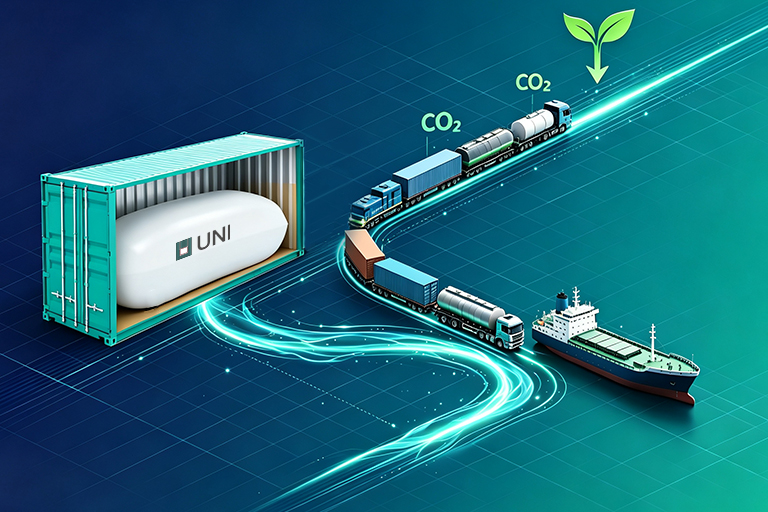
Empty packaging can create an often-overlooked environmental burden.
Reusable drums, IBCs, and ISO tanks may require return transportation after cargo delivery. ISO tanks may also require cleaning and repositioning before their next shipment, creating additional logistics movements and associated energy consumption.
Flexitanks are designed as single-use packaging solutions. After unloading, the used flexitank can be collected and processed according to applicable recycling and waste-management practices, eliminating the need for empty flexitank return transportation.
Less Cleaning and Resource Consumption
Reusable tanks and rigid containers require cleaning between compatible cargoes. This process consumes water, cleaning agents, energy, and labor, while also generating wastewater that needs to be treated.
With a new flexitank used for each shipment, the need for cargo-container cleaning can be significantly reduced. This helps simplify operations while reducing the resources associated with cleaning and preparation.
Supporting More Sustainable Bulk Liquid Logistics
The environmental benefits of flexitanks come from the overall logistics model rather than from packaging material alone: higher cargo utilization, lower packaging weight, reduced reverse logistics, and less cleaning can work together to reduce the environmental footprint of bulk liquid transportation.
At Uni Flexitank, we develop and manufacture flexitanks for a wide range of non-hazardous liquids, including edible oils, fruit juices, wine, base oils, polyols, plasticizers, surfactants, and other industrial liquids.
By helping customers transport more liquid cargo with simpler logistics and less packaging, Uni Flexitank supports more efficient and sustainable bulk liquid supply chains.
Choosing the right flexitank is not only a logistics decision—it can also be a step toward a lower-impact transportation model.
 Tel:+ 86 17512811383
 Fax:+ 86 17512811383
 E-mail:sales@uflexitank.com
 Add:No.1, Logisitcs Industrial Estates, Chigang Hill Haizhong Village Fangcun, Liwan District, Guangzhou, China