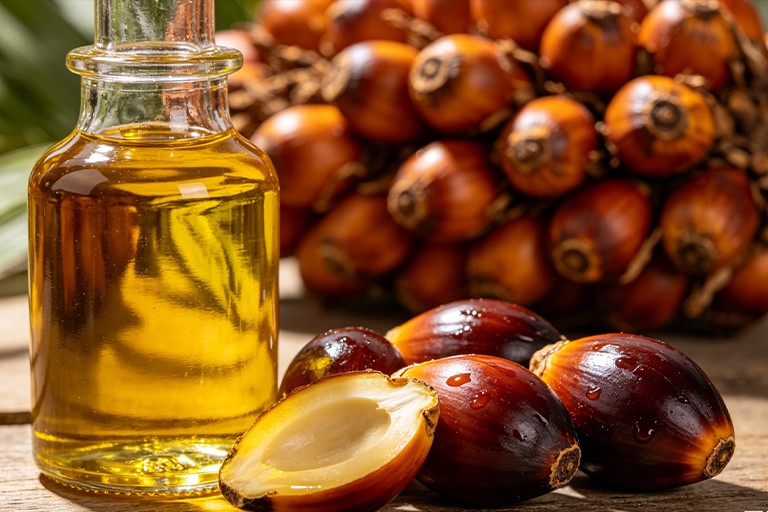


Palm oil is the world’s most widely produced and actively traded vegetable oil, alongside soybean oil and rapeseed oil as the “top three global vegetable oils.” According to the latest data from the United States Department of Agriculture, global palm oil production is projected to reach a record 80.7 million tons in the 2025/26 season, representing a year-on-year increase of approximately 3%.
Data from the Indonesian Palm Oil Association indicates that Indonesia’s crude palm oil output is expected to grow by about 7.19% year-on-year to 56.55 million tons in 2025. Meanwhile, the Malaysian Palm Oil Board forecasts Malaysia’s production to reach approximately 20.2 million tons in 2025, up around 4.9% from 2024.
With production continuing to rise, global palm oil trade volumes are expanding rapidly, driving increasing demand for efficient and cost-effective bulk transportation solutions.
Palm Oil: A Versatile Oil from Table to Industry
Palm oil’s position as the world’s leading vegetable oil is closely tied to its wide range of applications.
In the food sector, its excellent stability, strong oxidative resistance, and high smoke point make it widely used in instant noodles, biscuits, chocolate, ice cream, margarine, and blended cooking oils.
In industrial applications, palm oil and its derivatives serve as key raw materials for soap production, biodiesel, lubricants, and paper additives. In recent years, policies such as Indonesia’s “B40” biodiesel blending mandate have further expanded industrial demand for palm oil.
Meeting Bulk Demand: Why Flexitanks Stand Out
Facing massive shipment volumes, traditional transport methods—such as drums and tank containers—are increasingly constrained. Drums offer limited capacity, require intensive labor, and generate significant packaging waste. Tank containers involve high leasing costs, require repositioning of empty units, and demand complex cleaning processes with potential cross-contamination risks.
Flexitanks, by contrast, are ideally suited to the transportation characteristics of palm oil, effectively addressing these challenges:
l Cost Efficiency: Designed for standard 20-ft containers, flexitanks can load up to 24,000 liters per unit—approximately 35% more capacity than drum transport. As a single-use solution, they eliminate the need for return logistics and cleaning, significantly reducing tank container rental and maintenance costs. Overall logistics costs can be reduced by 30%–40%.
l Safety and Purity: Manufactured with food-grade multi-layer PE/PP materials compliant with FDA and EU standards, flexitanks provide excellent oxygen and contamination barriers, preventing oxidation and spoilage. Fully sealed systems ensure zero leakage, while the “one container, one flexitank” model eliminates cross-contamination risks and safeguards product quality.
l Operational Efficiency and Flexibility: Installation and loading can be completed by two operators in approximately 20 minutes, far exceeding the efficiency of traditional methods. Flexitanks are compatible with multimodal transport—including sea, rail, and road—enabling seamless integration into global logistics networks and supporting stable export flows from Indonesia and Malaysia to worldwide markets.
l Sustainability: Lightweight design helps reduce carbon emissions during transportation. After use, materials can be recycled, minimizing waste compared to drums or rigid containers and aligning with global green logistics trends.
As global palm oil trade continues to expand, flexitanks—offering low cost, high safety, superior efficiency, and strong adaptability—have become the preferred solution for large-scale bulk transportation. They empower businesses to capitalize on rising production, optimize supply chain efficiency, and ensure reliable, cost-effective delivery across global markets.
 Tel:+ 86 17512811383
 Fax:+ 86 17512811383
 E-mail:sales@uflexitank.com
 Add:No.1, Logisitcs Industrial Estates, Chigang Hill Haizhong Village Fangcun, Liwan District, Guangzhou, China